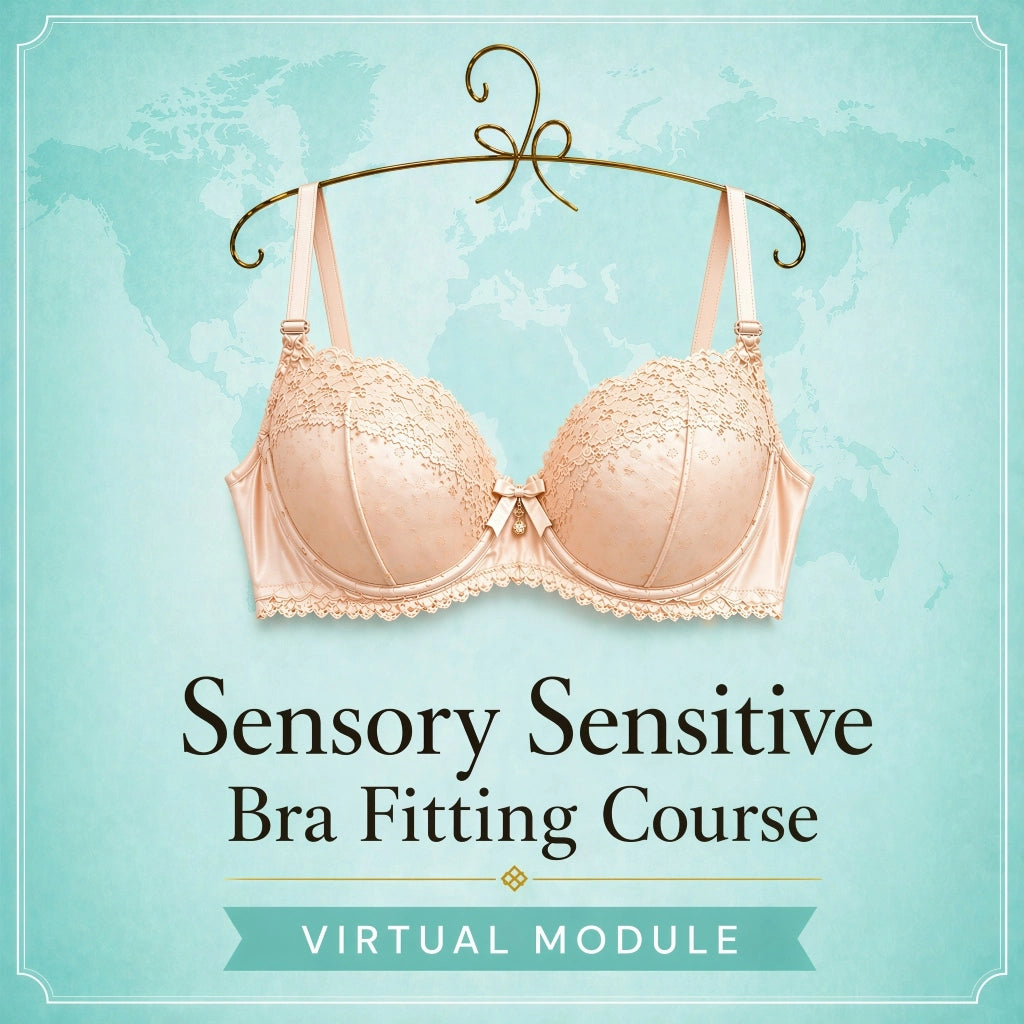
Over the past twenty years of teaching how to fit bras by eye, without a tape measure, I have emphasised the importance of not only finding the correct bra size for each person, but also allowing time when assessing the correct bra fit. Taking time not only ensures we find the right style and size for each person but we find the most comfortable bra for them because Comfort Always Wins." Lindsey Brown
Sensory Sensitive Bra Fittings
Comfort Wins by Lindsey Brown
Is Lingerie Ignoring the Neurodivergent Customer?
By Lindsey Brown - Bra Fitting Specialist with a Masters Research Degree in Lingerie Design specialising in compression of the breast tissue.
The lingerie industry has spent decades refining the technical aspects of bras with the increase of multiple cup sizes, shapes and lift. But one area we rarely discuss openly is how bras feel to wear.
Women all know the discomfort of wearing a bra that shall we say, has seen better days. For many women, comfort is the deciding factor in whether a bra stays on or off as soon as they get home. Or whether it ends up in the back of a drawer never to be worn again.
Whether the straps are digging in, an underwire pressing in the wrong place, or the wire casing causing rubbing or irritating the skin, discomfort quickly becomes the real reason that a bra is abandoned.
For neurodivergent women, particularly those with ADHD, that discomfort is not just inconvenient. It can be overwhelming.
Twenty Years of Saying the Same Thing: Comfort Always Wins
Over the past 20 years of teaching bra fitting to brands and boutiques I have also emphasised the importance of not only finding the correct bra size for that person but also allowing time when assessing fit correctly, we ensure the bra will be comfortable because “Comfort always wins”.
A bra that is technically the right size but feels wrong will not be worn. And a bra that is uncomfortable is not doing its job, for the customer or for the brand.
It was only recently that I had a real light-bulb moment about what “comfort” truly means. During a bra fitting session, I was working with two models. One mentioned she had ADHD.
The difference in their sensory responses to the same soft fabric was striking, not dramatic, not exaggerated, but clearly, unmistakably different.
One model barely registered the fabric at all. The other was acutely aware of every point of contact: the texture, the band tension, the placement of the seams and felt uncomfortable. That moment made me ask a question I haven't been able to stop thinking about since.
Are traditional bras and our bra fitting methods truly accommodating the needs of every customer who walks into a fitting room?
Just as bra sizes are not one-size-fits-all, neither is comfort. One person's level of comfort can be hugely different from someone with ADHD or other forms of sensory sensitivity.
The Sensory Reality of ADHD
There are an estimated 2.6 million people in the UK diagnosed with ADHD (1) and the actual number, including those undiagnosed or awaiting assessment, is widely believed to be significantly higher. This is not a fringe issue. It is a mainstream customer need.
Many women with ADHD experience what is known as sensory sensitivity, a heightened awareness of physical stimuli that neurotypical people might simply filter out without noticing. A scratchy label. A seam sitting at an angle that feels as if it's digging into the breast. A band that is fractionally too tight. A centre back fastening that rubs.
For most customers, these things are minor irritants, and they might just cut the label out. For a woman with ADHD, these irritations can become impossible to ignore and become a persistent distraction that makes wearing a bra an unpleasant experience.
Here is what makes this particularly relevant to our industry: The ADHD brain does not relate to sensory discomfort in the same way.
In practice this means a neurotypical customer might put on a new bra, feel the seam for the first few minutes, and then stop noticing it entirely as the brain learns to filter it. Whereas a customer with ADHD, or other sensory sensitivities, may feel that seam all day, every day, for as long as she wears the bra. The discomfort does not fade; if anything, awareness of it intensifies.
What the Data is Beginning to Suggest
I am currently conducting research into the sensory experiences of bra wearers, specifically exploring differences between neurodivergent and non-neurodivergent women.
In my pilot study 80% of all women reported that labels and tags in their bras annoy or bother them. That is not a niche complaint, that is a near-universal experience.
Perhaps more telling: when asked how quickly they know if a new bra feels uncomfortable, 80% of women said they knew immediately or within a few minutes. Not after a day's wear. Not after washing. Immediately.
60% of women in my pilot study reported either that underwire digs in, or that they have stopped wearing underwired bras entirely because of discomfort. For a customer with heightened sensory sensitivity, that number is likely to be even higher.
One participant, who identified as neurodivergent, described an experience of bra wearing that will resonate with many women but with an intensity that goes beyond everyday frustration. She is immediately aware when a bra feels wrong, noticing discomfort within minutes of putting it on. Labels and tags bother her immensely and she has stopped wearing underwired bras altogether because of the overall discomfort. She is not unusual in her struggles, but what her responses suggest is that for a neurodivergent wearer, there is very little margin for error. The bra either feels right, or it doesn't. And when it doesn't, it is not something she can simply ignore and get on with her day. She prefers to buy her bras in a larger store where she can assess the feel of a fabric herself, without engaging with anyone for help before committing to a purchase.
Many Fitting Rooms are Not Designed for Sensory Differences
The fitting room experience in busy stores can often feel rushed and sometimes awkward. The fitter is focused, rightly, on assessing bra size, some using tape measures, questions are mainly practical such as: Does the underwire sit flat? Is the band riding up? What is rarely asked is: How does this feel?
Such a pivotal question: How does it feel?
For a customer with ADHD or sensory processing differences, that question is arguably more important than any measurement.
A technically perfect fit that feels intolerable to the wearer is not a successful fitting. And if she leaves feeling worse than when she came in, overwhelmed, uncomfortable, perhaps embarrassed that she cannot simply explain how she feels in the bra, the experience may have actively put her off seeking a professional bra fitting ever again.
For those bra fitters who want to help the infamous 80% of women who are wearing the wrong bra size, perhaps the pivotal question is this: Do we truly understand what comfort means for the person standing in front of us in the fitting room?
What Good Looks Like for Boutiques
This is not about creating a separate category of bra fitting for neurodivergent customers. It is about slowing down and being aware of your customers' needs. For boutiques, it means not just advertising your great bra fitting service but also that you sell comfortable bras with soft fabrics.
It is about building sensory assessment into every fitting process because the answers are useful for every customer, not just those who have disclosed, or are aware of any sensory sensitivities.
It means knowing your fabrics. Being able to speak with confidence about explaining why one style of bra would be better than the other, why one feels softer than another.
It also means understanding that a customer who seems difficult to please or appears unable to decide on which bra to buy may not be being awkward. She may simply be processing far more sensory information than others.
Why Comfort Can and Should Always Win
Based on my research so far it seems clear that the brands and retailers who invest in training their teams, who think carefully about fabric and construction, who create fitting experiences that work for sensory-sensitive customers will not only be doing the right thing, they will be ahead of a conversation that is only going to grow louder.
Lindsey Brown, designer and bra fitting trainer, with a Masters in Compression of the Breast Tissue and 20+ years of industry experience. Copyright Lindsey Brown | The Bra Fitting Course. You can book onto our Sensory Sensitive Bra Fitting virtual training module.
Ref (1) ADHD Diagnosis Rate - Research Statistics ADHD UK
1
/
of
1
Bra Fitting Course
Sensory Sensitive Bra Fitting - Virtual Module
Regular price
£130.00 GBP
Regular price
Sale price
£130.00 GBP
Prices includes UK VAT
No Shipping required
Quantity
Share